Showing posts with label MV Doulos. Show all posts

Friday, July 27, 2012

Unscheduled Events - 1990.

Joining the the MV Doulos was the biggest milestone in my life - new environment, new people and tons of things to learn!  Leaving the port of Phuket itself was a big 'eye-opener' for me (I'll share that some other time) - such a culture shock.  The Straits of Malacca was a welcomed sight and calm seas as I stood on watch on the Bridge.  Our next stop?  The port of Penang, also known as "Pearl of the Orient."

As news of the invasion of Kuwait by oil big-league Iraq on the 2nd of August, 1990 reached our ears, well in short, it didn't matter much to me.  The war was "far away."  We soon entered port on the 3rd of August.  I never dreamt that one day I would be here again (the last time was in 1983.)  We berthed next to a British frigate as I could see the Royal Navy flag at the stern of the ship and spotting huge characters, F89. 


I took this picture as a RN seaman looked at me. - www.doulos1914.blogspot.com


The 'surprised' look that reflected from the british sailors were akin to saying, "Where did she come from?"  I think what they meant was, "Wow!  She's old!!"


'HMS Battleaxe'.  Photo credits to David Page - www.navyphotos.co.uk


Captain Richard Prendergast was captain of the Doulos and Chief Officer Mike O'Reilly was our First Mate together with Kim (S.Korea) and Sammy Salazar (Philippines) as our 3rd Mates.  Our captain was in the Royal Navy for 20 years so,..yes you're right - he went over to the Battleaxe not long after we docked.  Ship visits were very common among seamen as we travelled around the world, especially when it's our fellow countrymen, a 'get-together' is never far off.  I did that.

When we arrived, family members and friends of the Battleaxe crewmen were there to spend R & R with them but unfortunately (as we were told), a few days into their holiday, they were recalled and had to set course for the Gulf right away.  But not after I've had a chance to go aboard for a 'look-see' - we were only allowed on the helicopter deck.  Good enough!  After loading up with supplies the Battleaxe left port, we waved our 'goodbyes' and later it was our turn to 'sweep' the roadside stalls of Penang for food!!  "Burp!"


Wednesday, June 13, 2012

The Riveted Hull.

"Full Away!"  And the order 'steady as she goes' is being repeated back as we see that rudder slowly responding to the command.  Where were we?  Right!  Thought I'd lost you at my last post the Back End.  But let me draw your attention to the most obvious - rivets!  They're all along the hull of the MV Doulos, it is the aesthetic part of her that cannot be hidden but only to marvel.


ship rivet construction

www.doulos1914.blogspot.my


Like the stern design of the Medina, so was the use of rivets on the construction of this ship.  Fastenings used in traditional wooden boat building, like copper nails and clinch bolts, work on the same principle as the rivet but were in use long before the term rivet came about.  Hence, that technology 'overlapped' into the steel and iron industry - those 'nails' just got bigger.


Doulos rivets
www.doulos1914.blogspot.my

A rivet is a permanent mechanical fastener. Before being installed a rivet consists of a smooth cylindrical shaft with a head on one end. The end opposite the head is called the buck-tail. On installation the rivet is placed in a punched or drilled hole, and the tail is upset, or bucked (i.e., deformed), so that it expands to about 1.5 times the original shaft diameter, holding the rivet in place.

Because there is effectively a head on each end of an installed rivet, it can support tension loads (loads parallel to the axis of the shaft); however, it is much more capable of supporting shear loads (loads perpendicular to the axis of the shaft). Bolts and screws are better suited for tension applications.  It is said that the older-riveted ships were more 'flexible' in rough seas than the modern welded hulls.

Old ship construction using rivets

These are original riveting done when Medina was laid to keel in 1914.
You are looking at it in present times, how exciting! -  provided by www.ssmaritime.net

Plate section replaced on the Doulos

"Me" and Joe Saemala (Bosun). There was a little 'hole' we found this bilge section. We had it cut out and welded on with a new plate.  You can see the original construction using rivets in this photo. - www.doulos1914.blogspot.my


The story of the picture 'above' was that one day a few of us including myself was assigned to 'needle gun' the bilges in Hold No.1.  In other words to clear the area of rust, prepare the area concerned with coats of primer.  I was using the needle gun on a particular spot of thick rust and managed to remove a big chunk of it - there I noticed a dark, wet patch on the hull.  Sea water!  Mind you the Doulos was tied-up in port - that's the sea a few inches the other side of that steel plate!  "Oops!!"  I left that job for another.  We had it 'patched up' during dry dock in Hong Kong not long after that incident.  You can clearly see the rivets in the photo of the 'cutout'.


Hall of Names.  'Medina', just above the line and 'Franca C', behind the name 'Doulos'.  - www.doulos1914.blogspot.my


The three names of the ship from 1914 to 1977.  The name 'Roma' was not found here unfortunately.  It may have been 'painted' on the hull and replaced after that (we'll never know, but probably is), unlike the other 'three' which was welded on the hull.


The hull of the 'Medina' (MV Doulos 1991).  Hull thickness was astounding, it 'passed 'many certifications all through the years to continue sailing.  - www.doulos1914.blogspot.my


Today, in heavy steel fabrication, welding has almost completely replaced riveting as a means of making connections.  Welds require less preparation of the metal, do not reduce the effective cross-section, and take a minimum of space.  The miracle repeated itself year after year, one certification passed and then another - "Fit for service!"  The dock certifiers found that the thickness of the hull was still the same thickness of when it left Newport News in 1914!  Now that's a WOW!


Friday, June 1, 2012

The Back End.

One of the many 'interesting' features of the Doulos is the stern.  For those who are unfamiliar with nautical terms, the stern is the opposite of the bow.  No offense, we're all learning.  We have read in my other posts that the hull design dates back to the 1900's.  Not much have changed since the days it was built, except that more decks have been added and that the original bridge structure, raised higher.  The hull structure, Bridge, the propeller shaft and other fittings were the originals from the days of the Medina - the rest were added progressively during her years as a cruise liner.

Sister ship of Titanic

The Olympic, sister ship of the Titanic.


In the picture above, most ships were built with the 'counter stern' design.  Other names for the counter stern include a "elliptical stern," in reference to its very long counter and "cutaway stern." The counter stern began use during the age of sail, but remained very popular for both merchant and warships well into the nautical age of steam and through the first eight decades of steamship construction (roughly 1840–1920), despite the fact that the design left the rudder exposed and vulnerable in combat situations, therefore the design gradually was replaced with the cruiser stern.


Counter stern of a ship

The 'Counter stern' of the SS Medina. - provided by www.ssmaritime.net


Old Stern design

The deck where the two lines run through the 'fairlead' is the hull of the Medina. 
- provided by www.ssmaritime.net


Notice the hull plating riveted together in a longitudinal pattern and the four 'round eye' plates on the curvature of the stern (near the rudder post) , the same pattern as in the picture of the RMS Olympic, the sister ship of the RMS Titanic.  I cannot imagine enough to say again and again about the existence of such a living historical 'champion of the seas'.  Through the years, she has picked up bits of technological upgrades of between 1914 to 1977 and some upgrades again after that - all on the same hull.

Counter stern SS Medina

Another view of the stern - www.doulos1914.blogspot.my


Those 'bollards' on the deck in the picture below probably dates back to the days of the Medina.  They look old and pretty worn and weathered!

Old Medina stern

1990. ME on the winch controls at Aft Mooring stations. - www.doulos1914.blogspot.my

Do not be left at the back end, but do come up forward to share any thoughts, or extra information if you have; in any case, anything that you've learnt so far.  Cheers!!


Wednesday, April 25, 2012

We Were There.

drydock_old photo
An 'old' look of us during drydock in Kaoshiung, Taiwan.

No, it's not the RMS Titanic!  This ship was built in 1914, 2 years after the Titanic sank, she's the MV Doulos.  What a privileged to have sailed on her for two and a half years.  A tribute to her toughness.
Built as 'The Medina' in 1914 and sold as the 'Doulos Phos' in March 2010.  She was bought by a businessman and plans are to transform her into a floating hotel and restaurant-cum-museum in Singapore.  Thank God that 'our' ship is saved.  Saved for all to enjoy walking her decks again.

caulking wooden decks
Caulking the decks - my specialty.  Drydock Hong Kong 1991

The last time I was on the Doulos was a few years back.  By then the wooden decks were long gone, replaced with steel deck plating.  I recalled my earlier days of learning to caulk the decks from one dark, tall and (this is true) strong old seaman, Gunnar Stokke - our bo'sun.  He was a fisherman in Norway before he joined the ship.  This tall and gentle 'giant' was so smooth in his speech and character that I didn't dare to offend him.  I just listened and swallowed everything he taught me.  'Hook, line and sinker!'  That's the way.

By the way, I still have the mark on my forearm from a drop of hot melted pitch!  I was caulking one day and the pitch (or bitumen as some would say), dripped out of the large 'spoon' I was holding.  It would not 'run' off but I had to wait and endure the searing pain until it was hardened enough to be pulled off - along with the skin, of course!  Ever seen the 1979 sci-fi movie 'Alien', where the creature's blood dripped onto the floor??  Yeah, like that!

More coming up!  Look out for more postings and other accounts shared about this incredible ship.  Anything to share?  Post it in the comments section.


Monday, April 23, 2012

Underway 1914.


hamilton robert_mv doulos


YES! The MV Doulos was built 2 years after the building of the ill-fated Titanic was started.  That's what it means.  It took 26 months to complete the Titanic and we know what befell it right? The difference was that MV Doulos survived till the present time.  A miracle! 

I've been at sea for two and a half years from a 'green-horn' deckhand to a cadet officer on board the MV Doulos (1990-1992). The experiences of the Zamboanga Incident have been one poignant and victorious highlight of my time together with my ex-shipmates ever since.

I do not wish to displace or duplicate any account written and published by any individual or organisation, but this is purely my side of the passage.

All photos are my own unless specified and through permission 
I'd like to acknowledge Pastor Reuben Goossens (www.ssmaritime.net) for providing me some of his photos from his own research, which I would never have the opportunity to pursue.   And this is one ship you'll want to know about, especially to those who have walked her decks.  This is my 'boarding pass'.

mv doulos
    provided by www.ssmaritime.net

Built and ordered by the Mallory Steamship Company, her keel was laid on the very docks which in the future, some of the greatest warships, and biggest aircraft carriers will be built - the Newport News Shipbuilding and Drydocking Company.  Officially named "S.S. Medina" on the 22nd of August 1914 and a month later delivered to her owner for immediate operations.

River Medina
    provided by www.ssmaritime.net

The Medina (named after a Texan river, River Medina) was later converted to a tramp steamer, surviving the Great Depression of the 1930s with little changes.

All throughout the two wars, the Medina served in various flotillas.  Bearing many little scars, she eventually returned to the United States in 1946 a 'heroine'!  Even after its years of hazardous duty, the ship was not allowed to stay idle for long.

mv doulos history
    provided www.ssmaritime.net

There is also evidence that between 1918 and 1919, the Medina made a voyage to Bordeaux.  A signed document in which Roy W. Forbes was the First Mate is seen in the picture below.  He later became a Captain.

Roy W Forbes
      provided by www.ssmaritime.net

After the War, work began again to refit it.  After the hammering, chipping, and polishing, it left the dock in May 1949 looking quite attractive and bearing a new name, Roma.
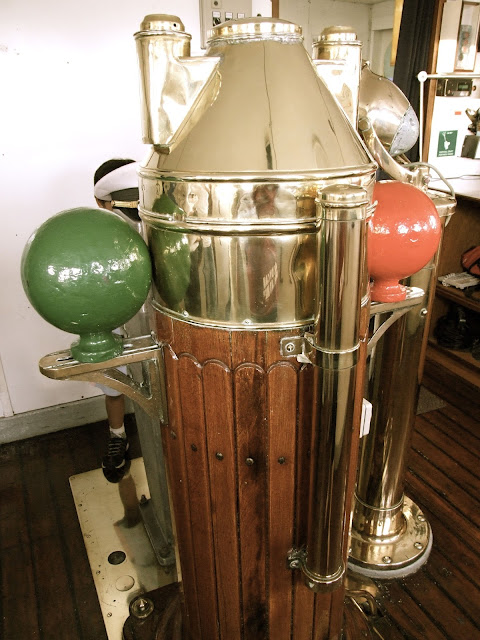
mv doulos compass binnacle
Compass Binnacle

Fast forward to the MV Doulos, one of the places I worked was on the Bridge.  Pictured above, is the steering station, and in front is the binnacle.  Originally meant for another ship, this compass binnacle (which houses the ship's magnetic compass), was put on the Medina's bridge instead.  And it has been there all throughout its life.  Thus, making it older than the ship itself!  The 'all-wood and brass' Bridge was the 'look' of its era and brings a sense of nostalgia to anyone who enters here.  Except for the 'modern-looking' joystick for steering, you won't see a working Bridge like this again, anywhere for that matter!

For most of my time on board, I stood here during watches with the others.  Depending on who's the OOW (Officer of the Watch), sometimes we, the bridge lookouts would take turns polishing the brass fittings.  After that, we'll make sure no one touches our 'artwork'!  There was that sense of pride nevertheless, it was, after all, we had touched the Medina.    During my last one year as a deck cadet, my cabin was just one staircase away, aft of the Bridge.

Note: Want to know what goes on in the ship's Bridge? Well just go to "Bridge Logbook" on my blog's sidebar on the right. 

Do subscribe so you will be able to continue the journey and not miss any 'yarn from this old sailor'. Feel free to share your comments here as well.